
A good architecture team knows what good design looks like. There are patterns for scalability, frameworks for modularity, and well-documented approaches for nearly every technical challenge an organization might face. Yet projects continue to fail, systems become unmaintainable, and digital transformation programs stall. The culprit is rarely a lack of knowledge about what to do. More often, it is a failure to recognize what not to do.
Architecture anti-patterns are recurring solutions that appear reasonable at the time of implementation but ultimately produce consequences that far outweigh their initial benefits. Unlike simple coding mistakes, these are errors of judgment at the structural level, decisions about how systems, components, and teams are organized that seem sound in the moment but erode an organization’s ability to adapt, scale, and deliver value over time.
What makes anti-patterns particularly dangerous is their subtlety. They accumulate silently, creating what practitioners often describe as a slow erosion, a gradual loss of velocity, rising maintenance costs, and increasing fragility that only becomes apparent when the damage is deeply entrenched and expensive to reverse. Understanding these anti-patterns is therefore not an academic exercise. It is a strategic imperative for any organization that depends on technology to compete.
Why Anti-Patterns Matter
Most architecture discussions focus on patterns, the proven approaches that teams should follow. While this is valuable, it only tells half the story. Anti-patterns deserve equal attention because they represent the traps that experienced professionals fall into precisely because they look like good ideas.
Consider a fundamental distinction that many organizations overlook: the difference between technical debt and architectural debt. Technical debt consists of localized, tactical flaws in code, duplicated logic, fragile scripts, deprecated frameworks. It is visible to developers and can typically be addressed through refactoring. Architectural debt, on the other hand, lives in the system landscape itself: in data flows, integration patterns, governance models, and the fundamental structure of how applications interact. If technical debt is a symptom, architectural debt is the underlying disease. And anti-patterns are frequently the root cause of that disease.
The costs of architectural mistakes are strategic rather than tactical. A developer may feel the pain when implementing a feature, but a proper fix requires unraveling code, changing established agreements, and coordinating across multiple teams. It is not easy to explain the need for such large-scale remediation or to get organizational approval for it. This is why anti-patterns persist, they are hard for individuals to fix, even when everyone acknowledges the problem.
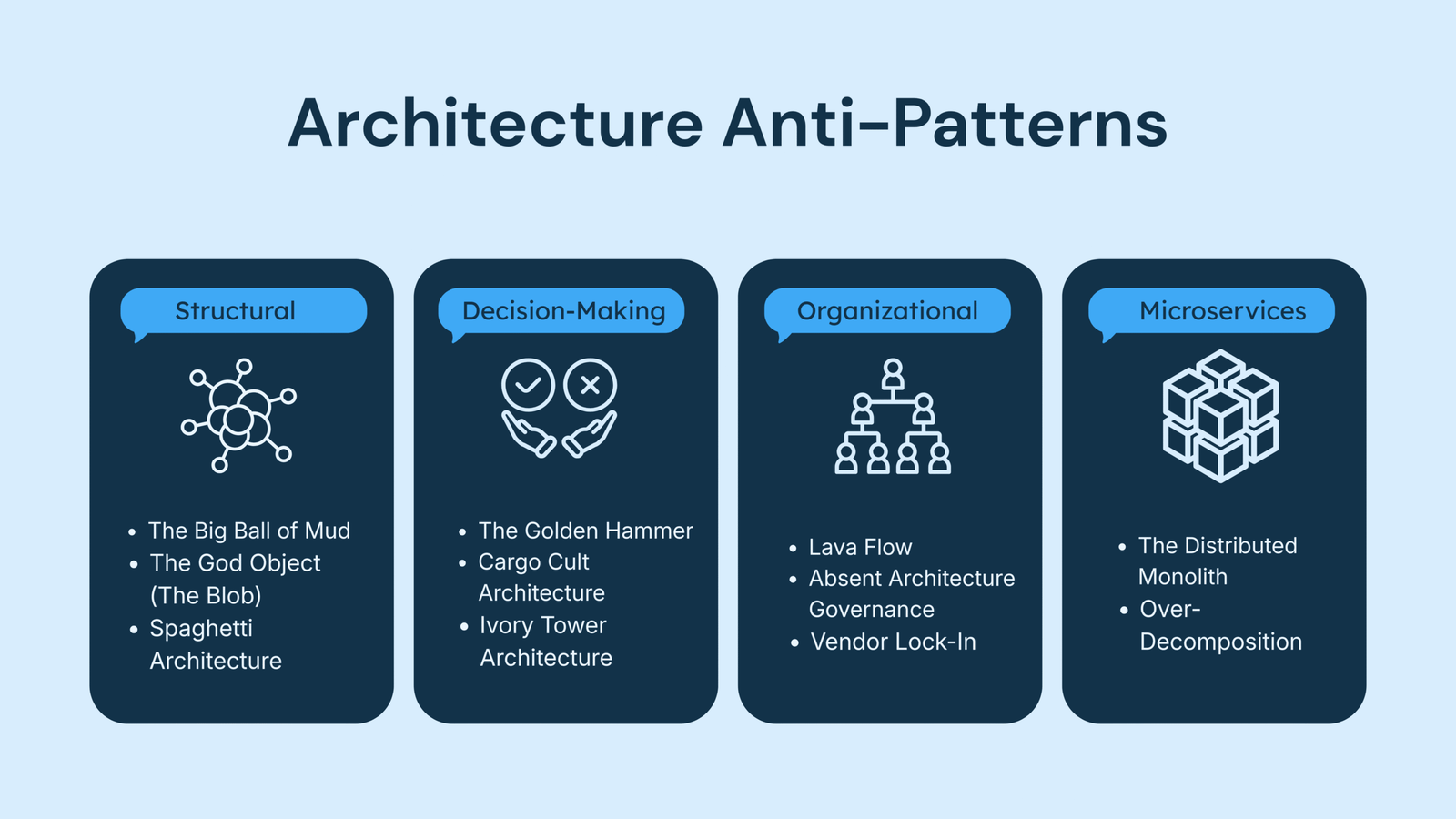
Structural Anti-Patterns
Structural anti-patterns relate to the fundamental organization of code and components. They emerge at the module and component level and are often the first signs that an architecture is headed in the wrong direction.
The Big Ball of Mud
Perhaps the most notorious anti-pattern in software architecture, the Big Ball of Mud describes a system that has grown to a point where it lacks any perceivable architecture or discernible structure. There are no clear boundaries between modules, no consistent layering, and no documentation that accurately reflects how the system actually works. Despite being universally recognized as undesirable, these systems are remarkably common in practice. They emerge through a combination of business pressures, developer turnover, and the natural entropy that affects all software over time.
The danger of the Big Ball of Mud is that it does not happen overnight. Architectures gradually deteriorate as deadline pressures lead to shortcuts, as new features are bolted on rather than integrated, and as the institutional knowledge of the original design is lost through team changes. By the time the problem is recognized, the cost of remediation can be staggering.
How to address it: Introduce clear architectural boundaries through incremental refactoring. Establish coding standards and enforce them through automated tooling and peer review. Define module responsibilities and make them explicit through documentation and architectural decision records. The goal is not a single heroic rewrite but a disciplined, sustained effort to restore structure.
The God Object (The Blob)
The God Object is a single, unfocused component that keeps growing by absorbing an excessive number of responsibilities. It typically starts as a convenient central class or service that handles a few related tasks. Over time, developers find it easier to add new functionality to this existing component rather than creating new ones, and the object gradually becomes the center of gravity for the entire system.
The consequences are predictable: every change to the system risks breaking something because so much logic is concentrated in one place. Testing becomes difficult because the component has too many dependencies. New developers struggle to understand a component that does everything, and parallel development becomes nearly impossible because multiple teams need to modify the same code.
How to address it: Apply the single responsibility principle systematically. Identify cohesive clusters of functionality within the God Object and extract them into dedicated components with clear interfaces. This is best done incrementally, extracting one responsibility at a time while maintaining backward compatibility.
Spaghetti Architecture
While spaghetti code is a well-known term, spaghetti architecture operates at a higher level of abstraction. It describes a system where modules and services are tangled together through complex, undocumented dependencies. Modifying one component has unpredictable ripple effects across the system, making every change a high-risk activity. The architecture may have started with a clean design, but organic growth, insufficient governance, and the pressure to deliver features quickly has created an interdependent web that no single person fully understands.
How to address it: Map all dependencies explicitly using architectural observability tools. Define clear contracts between components and enforce them. Introduce an event-driven or message-based communication layer to decouple direct service-to-service calls. Establish governance practices that require architectural review before new dependencies are introduced.
Decision-Making Anti-Patterns
Not all anti-patterns are structural. Some of the most damaging ones are rooted in how organizations make architectural decisions. These anti-patterns reflect cognitive biases, organizational dynamics, and cultural factors that lead teams to choose solutions that appear logical but are fundamentally misaligned with their actual needs.
The Golden Hammer
When you have a hammer, everything looks like a nail. The Golden Hammer anti-pattern describes the tendency of teams and architects to cling to familiar technologies, frameworks, or architectural approaches regardless of whether they are appropriate for the problem at hand. A team that has had success with microservices begins decomposing every application into services, even when a simpler monolith would serve the purpose. An organization that invested heavily in a particular database technology forces every project to use it, regardless of the data model requirements.
The root cause is often a combination of comfort and sunk cost. Teams naturally gravitate toward tools they know, and organizations resist abandoning technologies in which they have invested training and infrastructure. The result is solutions that are over-engineered for simple problems and under-engineered for complex ones.
How to address it: Establish technology evaluation frameworks that require teams to justify their choices against the specific requirements of each project. Encourage experimentation and skill development in alternative technologies. Create architecture review processes that challenge assumptions and ensure technology choices are driven by the problem, not by familiarity.
Cargo Cult Architecture
Cargo cult architecture occurs when organizations adopt processes, technologies, or methodologies without understanding why and how they work, expecting to achieve the same benefits as their role models. A company reads about how Netflix uses microservices and decides to adopt the same architecture without considering that Netflix has thousands of engineers, a mature platform team, and infrastructure that took years to build. The result is the ceremony without the substance, teams go through the motions of a sophisticated architecture without achieving any of its benefits.
This anti-pattern is particularly prevalent in the era of conference-driven development, where architectural trends spread rapidly through presentations and blog posts that showcase success stories without adequately conveying the context, constraints, and investment that made those successes possible.
How to address it: Before adopting any architecture pattern or technology, invest time in understanding the specific problem it solves and the trade-offs it introduces. Map the requirements and constraints of your organization against those of the case studies you are emulating. Start with small, contained experiments before committing to organization-wide adoption.
Ivory Tower Architecture
When architects focus solely on technology and consider the business problem domain to be someone else’s concern, they risk creating elegant solutions that fail to address real-world requirements. Ivory tower architecture is characterized by designs that are theoretically sound but impractical to implement, maintain, or evolve given the organization’s actual capabilities and constraints.
This anti-pattern often manifests as over-engineered solutions, in other words: systems with unnecessary levels of abstraction, excessive design patterns, or architectures so complex that a simpler approach would be sufficient to fulfill the business requirements. The architect may have created a technically impressive design, but the teams responsible for building and maintaining it lack the skills, time, or resources to realize its vision.
How to address it: Architecture choices should be aligned with the capabilities of the teams that will implement them. Involve developers early in architectural decisions. Accept that sometimes sacrificing architectural elegance in favor of a simpler solution is the right choice. Measure architectural success by business outcomes, not by theoretical purity.
Organizational and Governance Anti-Patterns
Some of the most impactful anti-patterns are not technical at all. They emerge from organizational structures, governance models, and cultural dynamics that shape how architectural decisions are made and enforced.
Lava Flow: Never Change a Running System
Almost everyone working in IT has heard the phrase: never change a running system. While stability is important, this mindset becomes an anti-pattern when it prevents necessary evolution. Lava flow describes the accumulation of dead code, obsolete components, and outdated architectural decisions that persist because no one is willing to touch them. The original developers have moved on, the documentation is incomplete, and the fear of breaking something outweighs the recognized need to modernize.
Over time, these calcified components become increasingly costly. They consume maintenance effort, create security vulnerabilities, and constrain the organization’s ability to adopt new technologies or respond to changing requirements. The longer they remain, the more dependent other systems become on their quirks and limitations.
How to address it: Implement regular architectural reviews that identify and prioritize legacy components for modernization. Use strangler fig patterns to incrementally replace outdated systems without big-bang rewrites. Invest in automated testing to reduce the risk associated with change. Most importantly, cultivate an organizational culture that treats architectural stagnation as a risk, not as stability.
Absent Architecture Governance
There is a perspective in some corners of agile practice that a formal architecture function is unnecessary when you have empowered, self-organizing delivery teams. The reasoning is sound up to a point: teams that have the skills and autonomy to make technical decisions can move faster than those that must consult external gatekeepers for every choice. However, this approach does not scale. As systems and organizations grow, architectural decisions become more complex, interrelated, and consequential.
Without governance, each team optimizes for its own context, leading to a fragmented landscape of inconsistent technologies, duplicated capabilities, and incompatible integration patterns. The absence of architectural oversight does not eliminate the need for architecture, it simply means that architecture happens by accident rather than by design.
How to address it: Establish lightweight but consistent governance frameworks that set boundaries without creating bottlenecks. Define architectural principles that guide decision-making at the team level. Create mechanisms for sharing architectural decisions across teams, such as architecture decision records and regular cross-team reviews. The goal is to enable autonomy within guardrails, not to create a central approval authority that slows everything down.
Vendor Lock-In
Vendor lock-in occurs when a system becomes so dependent on a specific vendor’s implementation that switching becomes prohibitively expensive or technically impractical. This anti-pattern is particularly common in cloud-native architectures, where the convenience of proprietary services can create deep dependencies that are invisible until the organization needs to change direction.
The risk is not merely theoretical. When vendors change pricing models, deprecate services, or delay features that your roadmap depends on, a locked-in organization has no leverage and limited options. The short-term productivity gains of using proprietary services can be dramatically outweighed by the long-term costs of dependency.
How to address it: Favor open standards from the beginning of any project. When proprietary services are used, create isolation layers that abstract the vendor-specific implementation from the rest of the application. Conduct regular assessments of vendor dependency risk and maintain contingency plans for critical services. The goal is not to avoid vendors entirely but to maintain the freedom to change direction when business needs require it.
Microservices Anti-Patterns
The adoption of microservices has introduced a new category of anti-patterns that deserve special attention, given how widely this architectural style has been adopted across the industry.
The Distributed Monolith
The distributed monolith is arguably the most common microservices anti-pattern. It occurs when an application is decomposed into services that are so tightly coupled and interdependent that they behave like a monolith distributed across a network. Services share databases, require coordinated deployments, and communicate synchronously in chains that make independent scaling and fault isolation impossible. The organization has inherited all of the complexity of a distributed system — network latency, partial failures, distributed debugging — without gaining any of the benefits of true service independence.
How to address it: Define clear service boundaries based on business domains, not technical layers. Implement database-per-service patterns to eliminate shared data stores. Favor asynchronous, event-driven communication over synchronous call chains. Design for independent deployability as a first-class requirement, not an afterthought.
Over-Decomposition
In the eagerness to embrace microservices, some teams break applications into far more services than necessary, splitting functionalities that could be efficiently managed within a single service. The result is excessive operational complexity: hundreds of services to deploy, monitor, and debug, with low cohesion within each service and high communication overhead between them. The infrastructure costs and cognitive load of managing this fragmented landscape often exceed the complexity of the monolith it replaced.
How to address it: Use domain-driven design to identify natural service boundaries based on business capabilities, not arbitrary technical divisions. Start with larger, coarser services and decompose further only when there is a clear business or operational justification. Remember that microservices are a means to an end, improved agility and scalability, not an end in themselves.
Understanding the Root Causes
Anti-patterns do not emerge in a vacuum. Understanding their root causes is essential to preventing them. Most architectural anti-patterns can be traced to one or more of these factors:
Urgency over deliberation. Aggressive deadlines and “just get it done” expectations push teams toward expedient solutions that create long-term structural problems. When there is no time for proper design, anti-patterns become the path of least resistance.
Knowledge gaps. Teams that lack experience with distributed systems, asynchronous communication, or data management in complex environments are more likely to make design decisions that introduce structural flaws. This is compounded when architects are unfamiliar with the business domain they are designing for.
Insufficient governance. Without architectural oversight, poor decisions go unchecked until their consequences become severe. Governance does not mean bureaucracy, it means having mechanisms to review, validate, and course-correct architectural decisions before they become entrenched.
Organizational inertia. Resistance to change, whether driven by comfort with existing tools, sunk-cost thinking, or fear of disruption, keeps organizations locked into anti-patterns long after the problems are recognized.
How to build Anti-Pattern Resilience
Recognizing anti-patterns is the first step. Building an organization that is resilient against them requires sustained, deliberate effort across multiple dimensions.
Invest in architectural observability. You cannot fix what you cannot see. Organizations need tools and practices that make the current state of their architecture visible, dependency maps, coupling metrics, deployment frequency data, and change failure rates. This visibility transforms anti-patterns from vague concerns into measurable risks.
Practice deliberative design. Critical architectural decisions should not be made casually. Establish processes that require teams to articulate the problem they are solving, evaluate alternatives, assess trade-offs, and document their reasoning. Architectural decision records provide an invaluable audit trail that helps future teams understand why decisions were made and when they should be revisited.
Make smaller, safer, and reversible changes. Large-scale architectural changes carry enormous risk. Favor incremental refactoring over big-bang rewrites. Use patterns like the strangler fig to replace legacy components gradually. Design changes to be reversible wherever possible, so that mistakes can be corrected quickly without catastrophic consequences.
Build a shared vocabulary. One of the most practical benefits of studying anti-patterns is the shared vocabulary they create. When a team can name a problem, when they can say “We’re building a distributed monolith” or “This is a golden hammer situation”, the conversation shifts from vague discomfort to focused problem-solving. Anti-patterns provide a language for discussing architectural risks constructively.
Conclusion
Architecture is as much about the decisions you avoid as the ones you make. Anti-patterns represent the collective wisdom of the industry, lessons learned through costly failures that, once understood, can be avoided. The organizations that take anti-patterns seriously are not the ones that never make mistakes. They are the ones that recognize mistakes early, have the governance structures to course-correct, and cultivate a culture where architectural health is treated as a strategic asset rather than a technical afterthought.
In an era where technology is the foundation of competitive advantage, the cost of ignoring architectural anti-patterns is measured not just in maintenance hours or infrastructure bills. It is measured in missed market opportunities, failed transformation programs, and the slow erosion of an organization’s ability to innovate.
The good news is that every anti-pattern has a known path to resolution. The challenge is not knowledge but commitment, the willingness to invest in architectural health before the symptoms become critical.
At Solvisse, we help organizations navigate the complexities of enterprise and data architecture with a practical, results-driven approach. Our team brings deep expertise across software architecture, data architecture, and technical debt management, enabling you to identify anti-patterns before they become entrenched, make informed technology decisions that align with your business strategy, and build architectures that support long-term agility. Whether you’re modernizing legacy systems, establishing architecture governance frameworks, or seeking to reduce the structural debt that’s slowing your teams down, Solvisse provides the specialized guidance you need to transform your IT landscape into a true competitive advantage.
Contact us to explore how we can help your organization build architecture resilience and avoid the hidden traps that undermine digital transformation.