
Is the productivity of your software organization declining? Is your codebase becoming increasingly difficult to evolve? As with many successful software endeavors, you may be suffering from the inability to manage friction in your software development, a pervasive case of technical debt.
The term technical debt was introduced by Ward Cunningham in 1992 to communicate the delicate balance between speed and rework in pursuit of delivering functioning, quality software. Cunningham was inspired by George Lakoff’s work on the power of metaphor, using the financial concept of debt to explain his software development decisions. Just as we borrow money to achieve goals more quickly, like buying a home, and then paying interest on that loan, software teams often make expedient decisions that create future obligations.
Every organization that creates nontrivial software systems has technical debt. Consider Facebook’s journey: the company originally used PHP to prototype and deliver their product quickly, but as they grew, they had to face the limitations of their early technical decisions. PHP simply could not scale to support their ever-growing user base, forcing Facebook to create a PHP transpiler called HipHop to address this accumulated debt. This reduced CPU load by half and served requests two and a half times faster.
What Is Technical Debt?
Technical debt consists of design or implementation constructs that are expedient in the short term but create a technical context that makes future changes more costly or even impossible. It is a contingent liability whose impact is limited to internal system qualities, primarily maintainability and evolvability. Think of it as friction in mechanical devices: the more friction a system experiences due to wear and tear, lack of lubrication, or poor design, the harder it becomes to move forward, and the more energy you must apply to achieve the original effect.
Technical debt is not synonymous with poor code quality, though many practitioners initially perceive it that way. Debt may accrue at the level of overall system design or architecture, even in systems with excellent code quality. It may also result from external events not under the control of the designers and implementers. The key distinction is that technical debt makes the system less maintainable and more difficult to evolve over time.
Principal and Interest
The financial metaphor of debt includes two fundamental concepts: principal and interest. In the software context, principal refers to the cost of remediating the debt, the effort required to fix the suboptimal design or implementation. Interest represents the recurring cost you pay when you do not fix the debt: increased development time, higher bug rates, and reduced team velocity.
When this gap between what was intended and what was actually built gets too large, the effects of technical debt become visible to end users in the form of bugs, quality problems, and software process slowdowns. Debt is simply a means to an end. In real life, if you do not repay what you borrow, more and more of your income goes to servicing your debt. In software, if we do not repay the debt by refactoring and improving our code, our debt may overwhelm us, spending all our effort fixing bugs while never getting to add the new features our customers truly value.
The Technical Debt Quadrant
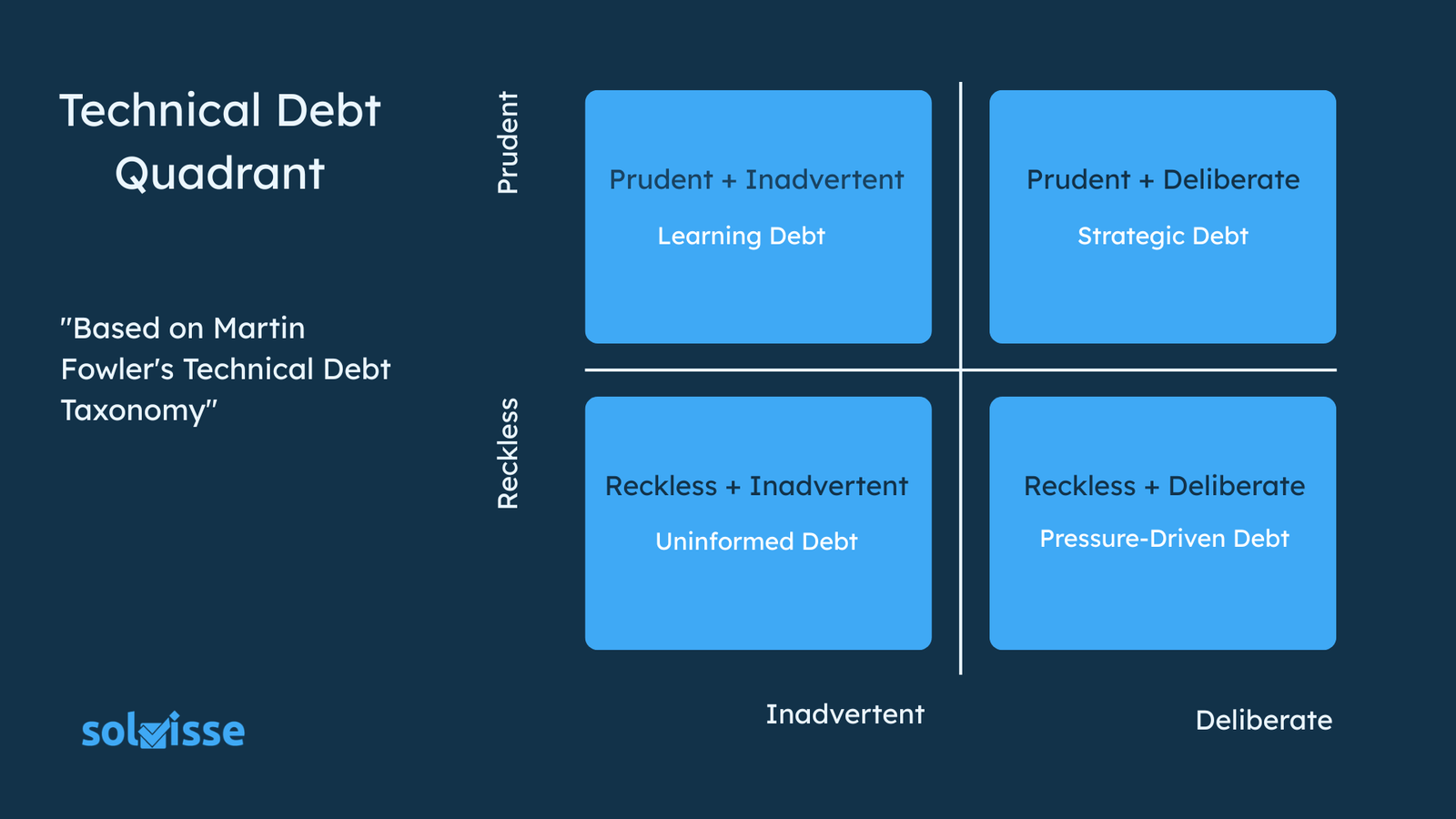
Martin Fowler created a useful taxonomy distinguishing two dimensions of debt. The first dimension explores whether the debt is reckless or prudent. If one simply codes without ever considering design, that would be reckless, equivalent to constructing a building without having an architect design or analyze it. On the other hand, debt may be strategic and prudent: when facing a hard deadline, or needing to prototype to get feedback and figure out what to build, taking on debt is often the wise choice.
The second dimension explores whether the debt is deliberate or inadvertent. There are times when debt is both deliberate and reckless, often the result of management decisions like agreeing to unrealistic deadlines or understaffing. However, there are also cases where debt is deliberate and prudent: the team knows they are taking shortcuts as a calculated investment, fully intending to pay back the costs of these decisions. Debt that is prudent and deliberate is good debt; this is why we obtain mortgages. Debt that is reckless and inadvertent is often the result of inadequate knowledge and training.
Types of Technical Debt
Technical debt manifests across multiple dimensions of a software project, extending far beyond source code.
Architecture Debt
Architecture technical debt carries the highest cost of ownership. Design decisions made early in a project’s lifecycle can create structural problems that affect every subsequent change. Architectural debt often results from shortcuts taken to meet deadlines, insufficient understanding of requirements at design time, or the natural evolution of a system beyond its original scope. This type of debt is particularly insidious because it remains invisible until major changes are attempted.
Code Debt
Code-level debt includes duplicate code, overly complex methods, poor naming conventions, and lack of proper abstractions. While often the most visible form of debt, code debt can usually be addressed through focused refactoring efforts. Static analysis tools can help identify code smells and quality issues, though they cannot capture the full picture of technical debt.
Requirements Debt
Technical debt in requirements is incurred when teams prioritize features that do not add value to the product. Evidence suggests only 20% of features in a given piece of software account for 80% of actual use, implying the remaining features were largely unnecessary. Poor requirements engineering, failing to talk to all pertinent stakeholders or accepting all customer requirements without discussion, creates debt that propagates through design and implementation.
Testing Debt
Testing debt accumulates when test coverage is inadequate, tests are poorly designed, or automated testing infrastructure is neglected. This form of debt makes it increasingly risky to make changes, as teams cannot confidently verify that modifications have not introduced regressions.
Documentation Debt
When documentation falls out of sync with the actual system, or when crucial architectural decisions are never recorded, documentation debt accumulates. This debt impacts onboarding of new team members and makes it difficult to understand why certain decisions were made.
Social Debt
There are numerous examples of projects driven into the ground not because their technology was inferior but because their organizational structure was pathological. Organizational smells include cognitive distance among peers with different backgrounds, excessive informality due to lack of information management protocols, premature deployment thinking a product is mature when it is not, and excessive similarity of processes across different subgroups.
What Causes Technical Debt?
Understanding the root causes of technical debt is essential for prevention. The causes fall into several categories.
Business Pressures
Schedule pressure is perhaps the most common cause. When deadlines loom, teams make compromises to deliver functionality. While sometimes necessary, these compromises create debt that must eventually be addressed. Market conditions, competitive pressures, and funding constraints all contribute to decisions that prioritize short-term delivery over long-term maintainability.
Changes in Context
Technology evolves rapidly, and what was once a sound architectural decision may become technical debt as the landscape changes. Regulatory changes, shifts in user expectations, and the emergence of new integration requirements can all transform previously adequate solutions into liabilities.
Development Process Issues
Lack of code reviews, inadequate testing practices, poor communication between teams, and insufficient architectural oversight all contribute to debt accumulation. When development processes do not include quality gates, debt accumulates silently until it becomes impossible to ignore.
People and Team Factors
Team turnover leads to loss of institutional knowledge. New team members may not understand why certain decisions were made and may inadvertently introduce debt through well-intentioned changes. Skill gaps, inadequate training, and lack of mentorship also contribute to unintentional debt.
Managing Technical Debt Strategically
Managing technical debt effectively requires moving beyond the metaphor into actionable measurement and management practices.
Make Debt Visible
The first step is making technical debt visible. Add technical debt items to your product backlog alongside features and bugs. Document the location, nature, and estimated cost of each debt item. This visibility enables informed decision-making about when and how to address accumulated debt.
Measure and Monitor
As any management scientist will tell you, if you cannot measure it, you cannot manage it. Track metrics that indicate debt accumulation: code complexity, test coverage, build times, and bug rates. Monitor trends over time to identify when debt is growing faster than it is being paid down.
Prioritize Strategically
Not all debt requires immediate attention. Focus on debt located in frequently changing, complex parts of the code. If a part of the system rarely changes, fixing its debt might be wasteful. Technical debt indicates parts of the codebase where large, lurking problems live. Prioritize debt that impacts your ability to maintain a competitive release pace.
Build the Business Case
Understanding debt and its consequences is likely not intuitively obvious to most members of your organization. You must build a business case for monitoring and paying back accumulated technical debt. Quantify the cost of interest payments in terms management understands: delayed features, increased bug rates, and reduced team productivity.
Conclusion: Living with Technical Debt
All systems have technical debt; this is a fundamental reality of software development. Technical debt is not inherently bad; like financial debt, it can be a strategic tool when used deliberately and managed carefully. The goal is not to eliminate all debt but to manage it effectively, ensuring that your software remains maintainable and evolvable over time.
The key insights for managing technical debt successfully include: recognizing that debt exists across all dimensions of software development from requirements to deployment; understanding that context determines whether specific debt is problematic; measuring and tracking debt to enable informed decisions; and building organizational awareness so that debt management becomes a shared responsibility rather than a technical concern hidden from business stakeholders.
Software development and technical debt can be controlled and managed. But this process must begin with measurement, awareness, and a commitment to treating technical debt management as one of the core software engineering practices.
Solvisse Vision on Technical Debt
At Solvisse, we believe that technical debt management is not merely a technical concern, it is a strategic imperative that directly impacts business outcomes. Our approach combines technical excellence with business acumen, recognizing that successful debt management requires understanding both the engineering realities and the business context.
We specialize in helping organizations identify, measure, and strategically address their technical debt. Our methodology begins with comprehensive architecture assessments that reveal hidden debt across code, design, and infrastructure. We help teams establish governance frameworks that prevent unintentional debt accumulation while enabling deliberate, strategic debt when business conditions warrant it.
Our proficiency spans the full spectrum of technical debt remediation: legacy system modernization, architecture refactoring, testing infrastructure improvement, and organizational transformation. We design phased implementation roadmaps that minimize risk while demonstrating value incrementally, ensuring that debt reduction efforts align with business priorities and deliver measurable improvements.
With a proven track record delivering solutions across industries, including financial services, healthcare, manufacturing, and retail, Solvisse combines deep technical expertise with a pragmatic understanding of business constraints. We do not advocate for eliminating all debt; instead, we help organizations develop the capability to make informed decisions about which debt to take on, which to pay down, and which to live with strategically.
Contact Solvisse to discuss how we can help your organization transform technical debt from a hidden liability into a managed strategic asset. We enable business transformation by ensuring your software foundation supports, rather than hinders, your competitive ambitions.